
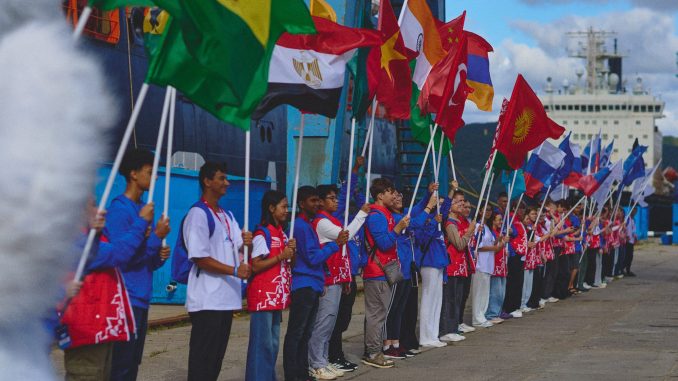
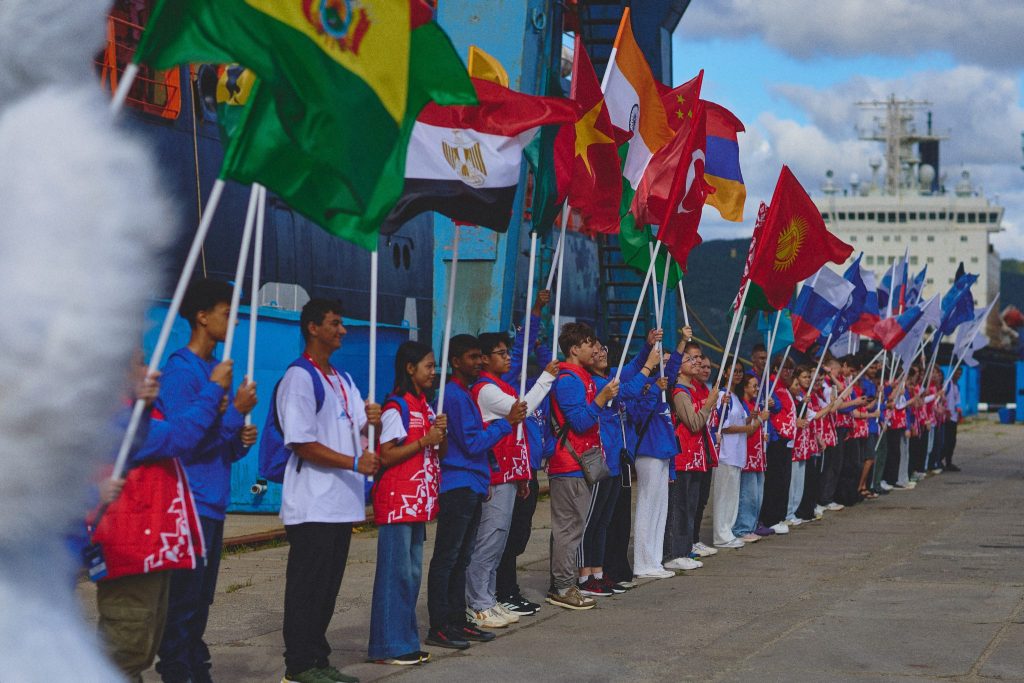
The finalists will embark on a unique expedition to the North Pole on the nuclear icebreaker 50 Let Pobedy
On June 23, the winners of the competitive selection among international participants of the “Icebreaker of Knowledge 2026” project, organized by the Autonomous Non-Profit Organization “Energy of the Future” with the support of the Rosatom State Atomic Corporation, were announced.
In the international track of the competition, nearly 5,000 talented school students aged 14 to 16 from Armenia, Bangladesh, Belarus, Bolivia, Brazil, Hungary, Vietnam, Egypt, India, Indonesia, Kazakhstan, China, Kyrgyzstan, Mongolia, Myanmar, Namibia, Rwanda, Serbia, Tanzania, Türkiye, Uzbekistan and South Africa competed for the opportunity to join the unique Arctic expedition.
A record number of applications were received from Kazakhstan (945 participants), Kyrgyzstan (827 participants), and Belarus (464 participants). Bangladesh and Myanmar also ranked among the most active countries this year. For some countries, participation in the expedition will be a historic event: their citizens will reach the North Pole for the first time.
The international selection process began on May 5 and consisted of three stages. During the first stage, participants answered questions in a science quiz, testing their knowledge of natural sciences, breakthrough technologies, nuclear energy, and Arctic exploration. The second stage included a series of webinars delivered by nuclear industry experts. Participants learned about Rosatom’s advanced solutions, including technologies used to ensure the safe and sustainable development of Arctic shipping, as well as the role of nuclear energy in the future of the global economy and science.
Based on the total scores for both stages, ten finalists in each country were selected. They advanced to the final round, where they presented creative video presentations on the topic “How Nuclear Technologies Are Changing the World Today”. In the final round, it was important for the participants not only to demonstrate their knowledge of the topic but also to demonstrate their ability to think outside the box, construct a compelling argument, and present the material in an engaging manner. The finalists’ projects were evaluated by an international jury comprising representatives of the nuclear industry, science, education, Arctic affairs and science communication, including Maria Fadeeva, Head of the Communications Department of the International Cooperation Centre of the Ministry of Education of the Russian Federation; Dmitry Kuzmitsky, Second Assistant Captain of Nuclear-Powered Vessels aboard the nuclear icebreaker Taymyr of FSUE Atomflot; Dmitry Chermoshentsev, Head of the Rosatom Quantum Technologies Research Group and the Quantum Optics Research Group at the Russian Quantum Center; Alexander Makarov, Director of the Arctic and Antarctic Research Institute; Chanto Khyn, Ambassador of Russian Nuclear Education and student of the Obninsk Institute for Nuclear Power Engineering of the National Research Nuclear University MEPhI (IATE NRNU MEPhI), majoring in Nuclear Power Engineering and Thermophysics; and Arctic blogger Alexey Zhirukhin.
“The Icebreaker of Knowledge is an amazing competition that combines the beauty of our planet, unique technologies, and wonderful people. The participants took a very responsible approach to the video-making process, and I thoroughly enjoyed watching their creative works! They went to great lengths to deepen their understanding of nuclear technologies and even suggest which of these technologies could improve people’s lives in their country. I am confident that the future is in good hands”, noted Dmitry Chermoshentsev, a member of the Icebreaker of Knowledge 2026 international jury, Scientific Group Leader in Rosatom Quantum Technologies, Principal Investigator in Russian Quantum Center.
“The participants of the Icebreaker of Knowledge competition impressed me with their depth of knowledge and creative approach. The participants are not merely showing interest in current technological topics; they are offering their own ideas. Their passion is the key to future progress and the successful resolution of global challenges”, emphasized Maria Fadeeva, a member of the Icebreaker of Knowledge 2026 international jury and Head of the Communications Department at the Center for International Cooperation of the Ministry of Education of the Russian Federation.
“When I first found visited the Arctic, I was amazed by its diversity: ice of different types and ages, majestic icebergs, vast open spaces, and amazing wildlife. It is a place with a unique character, power and beauty that cannot be fully conveyed through words or photographs — it has to be experienced firsthand. Moments like these remain in your memory for a lifetime, and I sincerely wish all expedition participants a chance to experience the full depth and diversity of northern nature, to discover its unique beauty and atmosphere. This expedition is a unique opportunity not only to see the Arctic and appreciate its global significance, but also to witness firsthand the vital role nuclear technology plays in the development of Arctic regions today», said Dmitrii Kuzmitskii, a member of the Icebreaker of Knowledge 2026 international jury and second officer of nuclear-powered vessels, nuclear icebreaker «Taimyr», FSUE Atomflot.
Alexander Makarov, a member of the Icebreaker of Knowledge 2026 international jury and Director of Arctic and Antarctic Research Institute (AARI): “Interest in the Arctic and its exploration goes far beyond Russia’s borders. Today, it is crucial to systematically and openly share with foreign audiences, especially children and young people, information about Russian Arctic research and the sustainable development of this unique region. Introducing the younger generation to the real work of scientists in expeditions builds a genuine understanding and appreciation of Arctic nature, inspires new discoveries, and strengthens international cooperation in science and sustainable development. Open dialogue creates the foundation for joint solutions for the future.”
“Initiatives like the Icebreaker of Knowledge play a crucial role in fostering young people’s interest in nuclear technology and scientific and technical professions. They give school students the opportunity to see science not as something complex and distant, but as a vibrant, modern, and promising field in which they can realize their potential and contribute to the future. It’s especially valuable that the project combines education, practical familiarity with the industry, and a strong motivational component: participants begin to better understand the demand for knowledge, engineering thinking, and international cooperation in the modern world. I am confident that projects like these help young people consciously choose their career paths and inspire the next generation to pursue science and engineering”, noted Chanto Khoeun, a member of the Icebreaker of Knowledge 2026 international jury, Russian Nuclear Education Ambassador, 4th-year Bachelor’s student at the OINPE NRNU MEPhI.
“The Icebreaker of Knowledge project is living proof that true science knows no borders. We are opening the Arctic to children from across the globe, showing them Russia’s unique technologies and the breathtaking beauty of the North Pole. By sharing our research with international audiences, we are nurturing a generation that will appreciate international cooperation and recognize Russia’s vital role in preserving this fragile region. Through educating young people from different countries, we are building strong bridges where only icy barriers once stood”, shared Alexey Zhirukhin, a member of the Icebreaker of Knowledge 2026 international jury and Arctic Ambassador.
The international Arctic expedition will bring together school students from different parts of the world, giving them an opportunity to visit the North Pole, broaden their understanding of the Arctic, modern nuclear technologies and the operation of the world’s only nuclear icebreaker fleet operated by Rosatom.
Names of the winners:
- Yuri Saribekyan (Armenia)
- Md. Malekul Salehin Prottoy (Bangladesh)
- Tikhon Korneenko (Belarus)
- Benjamin Reguerin (Bolivia)
- Júlia Passarini (Brazil)
- Sum Yau Lau (China)
- Rayan Ahmed Soliman (Egypt)
- Marcell Jeremejev (Hungary)
- Lucky Rawat (India)
- Galen Athaya Rinaldi Putra (Indonesia)
- Anna Ragozina (Kazakhstan)
- Meerim Turdumakhamatova (Kyrgyzstan)
- Vasilisa Markova (Mongolia)
- Phyo Thyu Min Thit (Myanmar)
- Joan Kathindi (Namibia)
- Louise Izere (Rwanda)
- Viktor Franolić (Serbia)
- Sithebe Amahle (South Africa)
- Xyleen Mapunda (Tanzania)
- Alper Tapki (Türkiye)
- Ezoza Beshimjanova (Uzbekistan)
- Khang Nguyen Dinh Trong (Vietnam)
On board the nuclear icebreaker, participants will take part in an extensive educational and scientific programme featuring Russian and international experts from the nuclear industry. The programme will include lectures, workshops, scientific experiments and other interactive activities. For the project winners, this is a unique opportunity to gain new knowledge from leading specialists and become part of an international community of talented young people interested in science and the technologies of the future.