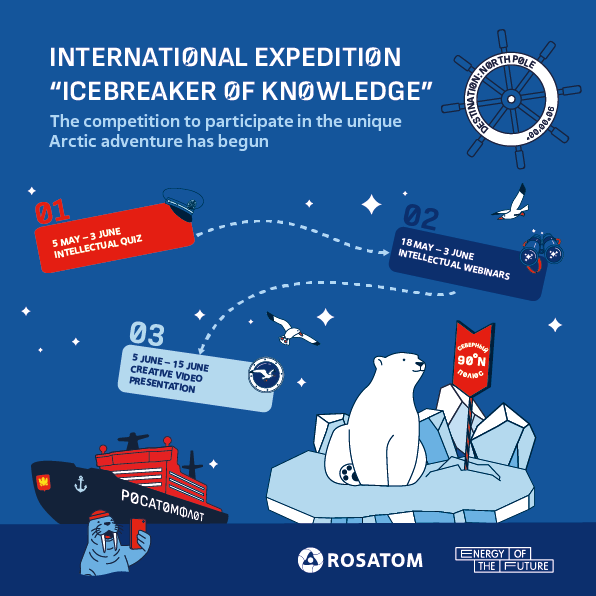
The competition for participation in the expedition to the North Pole on the nuclear icebreaker 50 Let Pobedy among schoolchildren from different parts of the world continues. The registered participants who succeeded at the quiz started the tasks of the second stage of the selection.
During the first two weeks of the competitive selection within the VII international scientific and educational project of Rosatom State Corporation “Icebreaker of Knowledge” there were over 1400 registrations from Armenia, Bangladesh, Belarus, Bolivia, Brazil, Hungary, Vietnam, Egypt, India, Indonesia, Kazakhstan, China, Kyrgyzstan, Mongolia, Myanmar, Namibia, Rwanda, Serbia, Tanzania, Turkey, Uzbekistan and South Africa. The number of participants at this stage has significantly exceeded the indicators of previous seasons – this confirms the growing interest in the project. The children have already had time to demonstrate their knowledge of the Arctic and have started the second stage: now they are waiting for a series of webinars on the topics of Rosatom’s promising solutions and they will answer questions based on the material covered after that.
“The first stage has already shown the high motivation and in-depth knowledge of the participants,” said Alexandra Yustus, Deputy Director General for Communications of the private institution Rosatom International Network. “We are happy that the geography of the project is expanding and interest in Rosatom technologies is growing. Now an intensive educational program awaits the participants – webinars delivered by leading experts.”
Competitive selection of foreign participants takes place on the website goarctic.energy. There is still an opportunity to complete the first and second stages of the selection process until June 3. Based on the results, the TOP 10 finalists with the highest scores will be selected in each participating country. They will advance to the third and final stage, where they will present their ideas related to the final assignment in the format of a video introduction. The best of the best will join the legendary Arctic expedition to the North Pole in August 2026.
BACKGROUND INFORMATION:
The scientific and educational project “Icebreaker of Knowledge” is organized with the support of Rosatom. It is aimed at promoting natural science disciplines and technologies of the nuclear industry, finding and supporting talented and gifted children, developing their abilities and offering career guidance. The project brings together school students and students of secondary vocational education programs aged 14–16 from around the world. The best participants join a scientific and educational expedition to the North Pole aboard the nuclear icebreaker 50 Let Pobedy.
The Northern Sea Route (NSR) is the shortest shipping route between the western part of Eurasia and the Asia-Pacific region and a historically established national transportation artery of Russia. Russia’s history of developing the Northern Sea Route spans more than 500 years and dates back to 1525, when Russian diplomat Dmitry Gerasimov proposed the idea of a shipping route through the seas of the Arctic Ocean.
In 2018, the Government of the Russian Federation granted Rosatom the authority of infrastructure operator of the Northern Sea Route. The corporation oversees the federal project “Development of the Northern Sea Route” and also participates in implementing the Northern Sea Route Development Plan through 2035 and the Russian Federation’s socio-economic development initiative through 2030 entitled “Year-Round Northern Sea Route,” approved by an order of the Government of the Russian Federation.
Russia is the only country in the world with a nuclear-powered icebreaker fleet. The fleet is operated by FSUE Atomflot, an enterprise of Rosatom. Today there are eight nuclear-powered icebreakers in the icebreaker fleet of FSUE Atomflot.
Rosatom and its enterprises pay special attention to supporting and developing educational, scientific, educational and cultural initiatives. They also participate in the creation of industrial partnership departments in Russian universities, implementation of scholarship support programs, major educational projects, organization of internships and apprenticeships for students with subsequent employment.